Civil Rights 4.04
Roe v. Wade - 1973
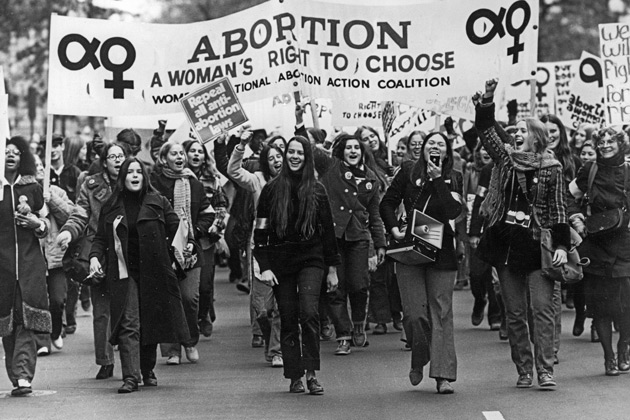
Appellant Norma McCorvey (known as Jane Roe in court documents) presented the case of a woman's right to terminate pregnancy by abortion. In the state of Texas, it was illegal to terminate a pregnancy unless the mother's life was in danger. Roe fought that taking away the right of ending a pregnancy was in violation of the Constitution. She wanted help from women's rights advocates on this issue. They decided to help her fight against the Texas law of banning abortion.
The Supreme Court decided that the right to a women's to an abortion had the right to privacy, as protected by the 9th Amendment. The 9th Amendment states that the rights not listed in the Constitution belong to the people. A woman is able to terminate her pregnancy within the first trimester. During the second and third, the decision is then left up to the state.
The right to abortion is a very controversial topic. Many interest groups, and political candidates have taken a stand on the issue.
The Supreme Court decided that the right to a women's to an abortion had the right to privacy, as protected by the 9th Amendment. The 9th Amendment states that the rights not listed in the Constitution belong to the people. A woman is able to terminate her pregnancy within the first trimester. During the second and third, the decision is then left up to the state.
The right to abortion is a very controversial topic. Many interest groups, and political candidates have taken a stand on the issue.
Miranda v. Arizona - 1966
Petitioner Ernesto Miranda argued that it was unconstitutional that he was not informed of his fifth amendment rights before being interrogated. Ernesto Miranda was arrested for the connection to a kidnapping and rape. Police interrogated Miranda for two hours before receiving a written confession. During the trial the confession was used as evidence. The defense attorney stated that the police officers did not inform Miranda of his rights to an attorney before the interrogation. The Supreme Court of Arizona stated that Miranda's constitutional rights were not violated because he never requested counsel.
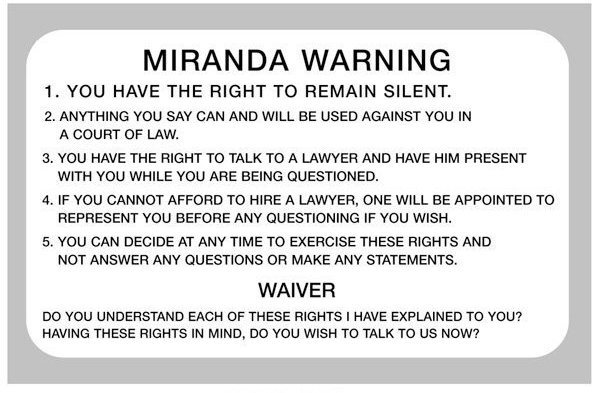
The Supreme Court ruled that the 5th Amendment on self-incrimination is available in all places. It was then passed, that before information from any interrogation can be used the suspect must be aware of his/her rights. These safeguards include proof that the suspect knows and understands their rights. Without this proof the judge can refuse to allow what the suspect said during the arrest as evidence in the trial. This warning is now known as the "Miranda Rights" or "Miranda Warning".
The Supreme Court ruled that the 5th Amendment on self-incrimination is available in all places. It was then passed, that before information from any interrogation can be used the suspect must be aware of his/her rights. These safeguards include proof that the suspect knows and understands their rights. Without this proof the judge can refuse to allow what the suspect said during the arrest as evidence in the trial. This warning is now known as the "Miranda Rights" or "Miranda Warning".
19th Amendment - Ratified 1920
"The rights of citizens of the United States to vote shall not be denied or abridged by the United States or any other State on account of sex.
Congress shall have power to enforce this article by appropriate legislation."
After the ratification of the 15th Amendment, the rights of former slaves to vote expanded suffrage of millions of African American men over the age 21. The ratification of the 19th Amendment now protected women's suffrage. Just like the 15th Amendment did for African Americans, the 19th Amendment opened the door for women to be able to vote in every state.
Beginning in 1848 the movement for women's rights bloomed, starting with a convention in New York. It was organized by abolitionists like Elizabeth Cady Stanton, Lucretia Mott, and later Susan B. Anthony. The right to vote became the focal point of women's rights movements. Many organizations were formed that lobbied the governments to grant access to women to vote, and raised public awareness. 70 years later they were granted the passage of the 19th Amendment.
Congress shall have power to enforce this article by appropriate legislation."
After the ratification of the 15th Amendment, the rights of former slaves to vote expanded suffrage of millions of African American men over the age 21. The ratification of the 19th Amendment now protected women's suffrage. Just like the 15th Amendment did for African Americans, the 19th Amendment opened the door for women to be able to vote in every state.
Beginning in 1848 the movement for women's rights bloomed, starting with a convention in New York. It was organized by abolitionists like Elizabeth Cady Stanton, Lucretia Mott, and later Susan B. Anthony. The right to vote became the focal point of women's rights movements. Many organizations were formed that lobbied the governments to grant access to women to vote, and raised public awareness. 70 years later they were granted the passage of the 19th Amendment.

Civil Rights Act of 1964
In the summer of 1964, the Civil Rights Act was passed, which expanded civil rights protections. The act limited segregation in schools, restaurants and other public places. It also limited the use of literacy tests for voting. Literacy tests were still used for things like the naturalization process, and private clubs. The new act authorized Congress the rule from the Brown case in schools, and sending military to support federal courts. It also helped to prevent discrimination in hiring, firing, and paying employees. The Civil Rights Act of 1964 banned discrimination in any activity receiving federal assistance.
The three branches passed Public Law 88-352, which forbade discrimination on the basis of sex, race, color, national origin, or religion in a work environment. Title VII of the act created the Equal Employment Opportunity Commission to enforce the law. Congress asserted its ability to enforce the act through the Constitution. This includes the ability to regulate interstate commerce, the duty to guarantee all citizens equal protection laws under the 14th Amendment, and the duty to protect all citizens voting rights under the 5th Amendment.
This act strengthened our country by making it a more equal place for women and people of other races, origin, and religion. Although it is not perfect, the Civil Rights Act of 1964 has brought us closer to a goal of equality.
This act strengthened our country by making it a more equal place for women and people of other races, origin, and religion. Although it is not perfect, the Civil Rights Act of 1964 has brought us closer to a goal of equality.

CITES:
Roe v. Wade - 1973
>"Roe v. Wade." Oyez, https://www.oyez.org/cases/1971/70-18. Accessed 6 Apr. 2017.
Miranda v. Arizona - 1966
>"04.04 Civil Rights: Landmark Cases." 04.04 Civil Rights: Landmark Cases. FLVS, n.d. Web. 07 Apr. 2017.
>"Miranda v. Arizona." Oyez, https://www.oyez.org/cases/1965/759. Accessed 7 Apr. 2017.
>DuMond, John. "Posts about You Have the Right to Remain Silent on Nobody Move!"Nobody Move. Word Press, 13 June 2016. Web. 07 Apr. 2017.
Civil Rights Act of 1964
>"The Civil Rights Act of 1964 and the Equal Employment Opportunity Commission." National Archives and Records Administration. National Archives and Records Administration, 09 Oct. 2016. Web. 08 Apr. 2017.
>Rodriguez, Kim. "Roe v. Wade Revisited." Odyssey. Odyssey Media Group, 27 June 2016. Web. 07 Apr. 2017.
Miranda v. Arizona - 1966
>"04.04 Civil Rights: Landmark Cases." 04.04 Civil Rights: Landmark Cases. FLVS, n.d. Web. 07 Apr. 2017.
>"Miranda v. Arizona." Oyez, https://www.oyez.org/cases/1965/759. Accessed 7 Apr. 2017.
>DuMond, John. "Posts about You Have the Right to Remain Silent on Nobody Move!"Nobody Move. Word Press, 13 June 2016. Web. 07 Apr. 2017.
19th Amendment - Ratified 1920
> History.com Staff. "19th Amendment." History.com. A&E Television Networks, 2010. Web. 07 Apr. 2017.
> Sydney. "Amendments 19, 21 & 26." Amendments. Weebly, n.d. Web. 07 Apr. 2017.
> History.com Staff. "19th Amendment." History.com. A&E Television Networks, 2010. Web. 07 Apr. 2017.
> Sydney. "Amendments 19, 21 & 26." Amendments. Weebly, n.d. Web. 07 Apr. 2017.
Civil Rights Act of 1964
>"The Civil Rights Act of 1964 and the Equal Employment Opportunity Commission." National Archives and Records Administration. National Archives and Records Administration, 09 Oct. 2016. Web. 08 Apr. 2017.
>"Civil Rights Act of 1964 Explained." Civil. Civil Laws, n.d. Web. 08 Apr. 2017.
>Jackson, Abby. "20 Dramatic Photos of the Movement That Came before the Civil Rights Act Was Signed 51 Years Ago Today." Business Insider Australia. Allure Media, 02 July 2015. Web. 08 Apr. 2017.
>Jackson, Abby. "20 Dramatic Photos of the Movement That Came before the Civil Rights Act Was Signed 51 Years Ago Today." Business Insider Australia. Allure Media, 02 July 2015. Web. 08 Apr. 2017.
Comments
Post a Comment